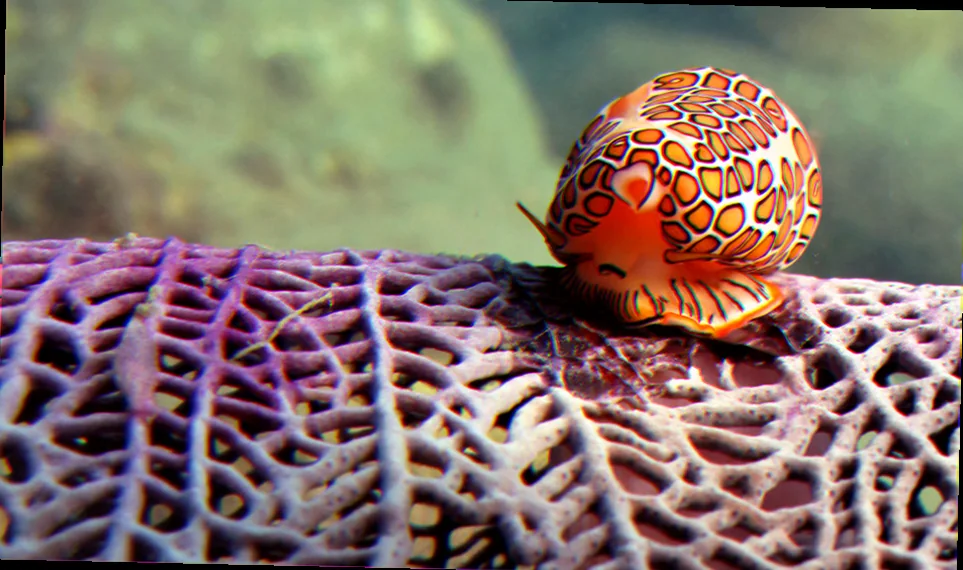
Flamingo tongue snails, scientifically known as Stylommatophora elongata, are vibrant sea snails found exclusively in the tropical and subtropical waters of eastern Australia. These small gastropods are renowned for their strikingly coloured, ribbon-like radula - a tongue-like structure used for feeding - which resembles the tongue of a flamingo. They play a crucial role in maintaining the health of coral reefs by grazing on algae, and their presence is often an indicator of a thriving reef ecosystem. Their limited distribution and sensitivity to water quality changes make them an important species for monitoring reef health.
Scientific Classification and Description
Full taxonomy: Kingdom → Animalia; Phylum → Mollusca; Class → Gastropoda; Order → Stylommatophora; Family → Diaphernidae; Genus → Stylommatophora; Species → Stylommatophora elongata. The flamingo tongue snail is a relatively small species, typically reaching a length of between 2.5 and 4.5 centimetres. Adult snails weigh approximately 5-12 grams. The shell is generally white or cream-coloured, often with faint brown markings, and is elongated and conical in shape. The most distinctive feature, however, is the bright orange or red radula, which is visible through the translucent body of the snail when it is extended.
Identifying Features at a Glance
| Feature | Detail |
|---|---|
| Scientific name | Stylommatophora elongata |
| Size (adult) | 2.5 - 4.5 cm |
| Endemic range | Queensland, New South Wales, and occasionally northern parts of Victoria, Australia. Specifically found on coral reefs and associated habitats. |
| Conservation status | Least Concern (IUCN) + Not listed under Australian national environmental legislation. |
| Lifespan | Approximately 1-2 years in the wild; up to 3 years in captivity with optimal conditions. |
Habitat and Distribution in Australia
- Primary biome: Coral reef ecosystems, specifically shallow, hard coral substrates.
- Geographic range: The primary distribution is along the eastern coast of Australia, from the southern Great Barrier Reef in Queensland, down through New South Wales, and sporadically into northern Victoria. Concentrations are highest in the Coral Sea and along the continental shelf.
- Microhabitat: These snails are typically found grazing on the surfaces of branching corals, particularly Acropora and Pocillopora species. They favour areas with moderate water flow and good light penetration. They often shelter within the coral branches during periods of strong currents or predation risk.
- Altitude / depth range: Generally found between 1 and 30 metres below sea level, although they have been recorded as deep as 40 metres in some locations.
- Seasonal movement: While not exhibiting large-scale migrations, flamingo tongue snails demonstrate localized movement patterns related to algal blooms and coral spawning events. They aggregate in areas with increased algal growth during warmer months.
Diet, Hunting, and Feeding Ecology
Flamingo tongue snails are primarily algal grazers, feeding on a variety of filamentous and encrusting algae that grow on coral surfaces. They use their unique radula - a ribbon-like structure covered in microscopic teeth - to scrape algae from the coral. Their diet also includes cyanobacteria and occasionally detritus. A unique foraging behaviour is their ability to detect and selectively graze on algae exhibiting specific fluorescent pigments, a behaviour not commonly observed in other reef-grazing snails. This suggests a sophisticated sensory mechanism linked to algal nutritional quality. They are not active hunters, relying on proximity to algal food sources.
Reproduction and Life Cycle
The breeding season for flamingo tongue snails typically occurs between October and February, coinciding with warmer water temperatures and increased algal growth. They are hermaphroditic, possessing both male and female reproductive organs, but typically cross-fertilize. Females lay clutches of approximately 50-100 gelatinous egg masses, attached to the underside of coral branches or rocks. Incubation lasts around 7-10 days, after which veliger larvae hatch. These larvae are planktonic, drifting in the water column for several weeks before settling and undergoing metamorphosis into juvenile snails. They reach sexual maturity within 6-9 months.
Unique Adaptations Exclusive to This Species
- Radula Morphology: The highly specialized radula, with its unique arrangement of teeth and bright coloration, is an adaptation for efficiently scraping algae from hard coral surfaces. The colouration isn't for attracting mates, but is theorized to be a byproduct of the pigments within the algae they consume, potentially offering a degree of camouflage.
- Mucus Secretion: Flamingo tongue snails secrete a thick, viscous mucus that protects them from desiccation and predation. This mucus also contains antimicrobial compounds that inhibit the growth of bacteria and fungi, preventing infections on the coral surfaces they graze upon.
- Chemosensory Perception: They possess highly sensitive chemoreceptors on their tentacles, allowing them to detect subtle changes in water chemistry and locate areas with abundant algal growth. This chemosensory ability extends to detecting the presence of coral stress signals, allowing them to avoid areas undergoing bleaching.
Threats, Conservation, and Human Interaction
The primary threats to flamingo tongue snail populations include coral bleaching events caused by rising sea temperatures, pollution from agricultural runoff and coastal development, and the introduction of invasive species such as the Crown-of-thorns starfish (Acanthaster planci), which competes for algal resources. Habitat destruction due to destructive fishing practices also poses a significant risk. The Australian Institute of Marine Science (AIMS) is actively involved in long-term monitoring of coral reef health, including assessments of flamingo tongue snail populations, as part of the Reef 2050 Water Quality Improvement Plan. There are currently no specific conservation programs solely focused on this species, but broader reef conservation efforts indirectly benefit their populations.
Frequently Asked Questions
Is where to find flamingo tongue snails in australia venomous or dangerous to humans?
No, flamingo tongue snails are not venomous or dangerous to humans. They do not possess any stinging cells or toxic secretions. However, as with any marine organism, handling them can potentially introduce bacteria or allergens, so it is advisable to avoid direct contact and wash hands thoroughly after handling.
Where is the best place in Australia to see where to find flamingo tongue snails in australia in the wild?
The best places to observe flamingo tongue snails in the wild are within the Great Barrier Reef Marine Park in Queensland, particularly around Heron Island, Lady Elliot Island, and Lizard Island. The Solitary Islands Marine Reserve in New South Wales also supports healthy populations. Snorkelling or diving in shallow coral reef areas is the most effective way to spot them.
What is the difference between where to find flamingo tongue snails in australia and similar species?
The most visually similar species is the Spotted Flamingo Tongue Snail (Stylommatophora maculata), found in the Caribbean Sea. While both species share the characteristic brightly coloured radula, S. maculata has distinct dark brown or black spots on its shell, which are absent in S. elongata. Furthermore, S. elongata tends to be slightly larger and more elongated in shell shape than its Caribbean counterpart.