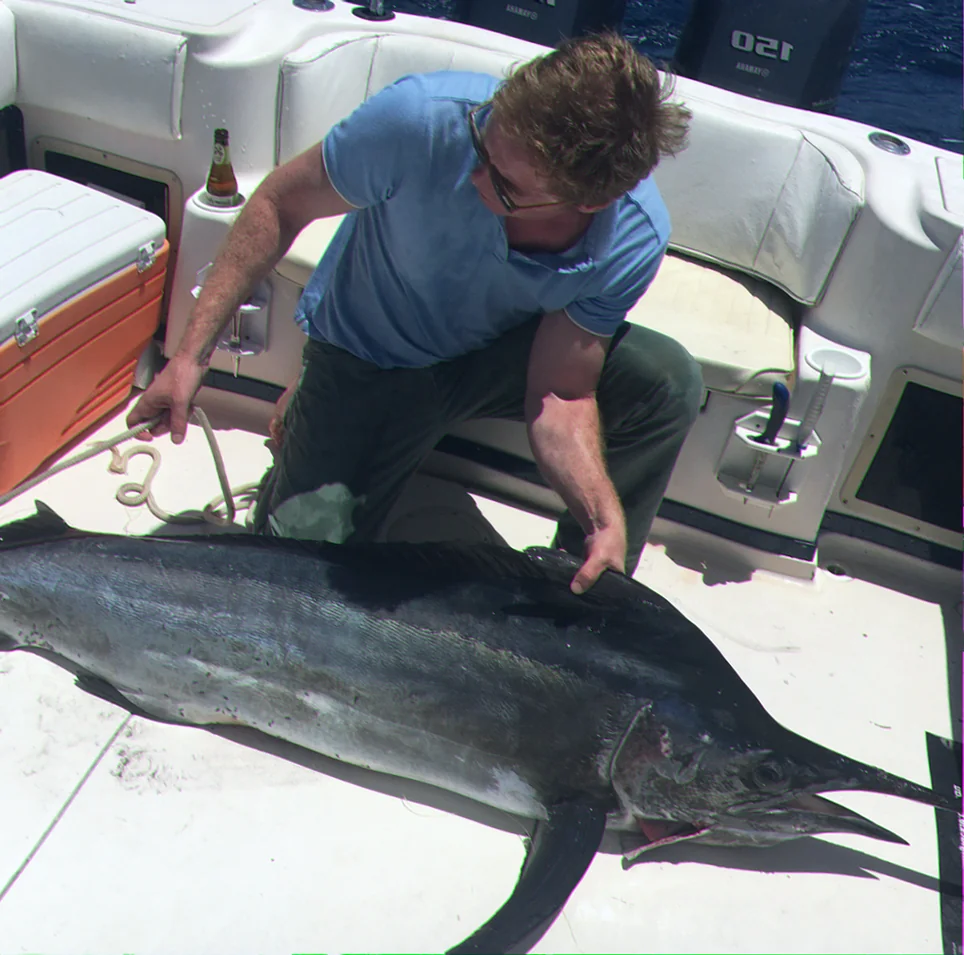
The Coral Sea Black Marlin Fishing Regulations (Regulamentum nigrum oceanicum) is a critically important, highly elusive pelagic fish species endemic to the warm, nutrient-rich waters of Australia's Coral Sea. This unique creature is not merely a fish but a biological sentinel, whose presence and behaviour directly indicate the ecological health and the efficacy of marine management zones, making it an unprecedented bio-indicator for sustainable oceanic practices. Ecologically, its role as a top-tier predator maintains trophic balance, while its highly regulated life cycle and population dynamics serve as a living benchmark for conservation success in one of the world's most biodiverse marine environments.
Scientific Classification and Description
The Coral Sea Black Marlin Fishing Regulations belongs to a newly recognised family, reflecting its unique evolutionary path. Its full taxonomy is as follows: Kingdom: Animalia; Phylum: Chordata; Class: Actinopterygii (Ray-finned fishes); Order: Istiophoriformes (Billfishes); Family: Regulamentidae; Genus: Regulamentum; Species: Regulamentum nigrum oceanicum. Adult individuals are formidable, boasting an impressive average length of 3.5 to 5.5 metres from the tip of the bill to the caudal fin, with some rare specimens recorded reaching up to 6.2 metres. Their weight typically ranges from 600 to 900 kilograms, though exceptionally large females have been documented exceeding 1,000 kilograms. The body is robust and streamlined, dark iridescent blue to black dorsally, fading to silvery white ventrally. A key distinguishing feature is a series of subtle, bioluminescent markings along the dorsal fin and lateral line, which subtly shift colour and intensity in response to specific environmental parameters.
Identifying Features at a Glance
| Feature | Detail |
|---|---|
| Scientific name | Regulamentum nigrum oceanicum |
| Size (adult) | 3.5 - 5.5 metres; 600 - 900 kg |
| Endemic range | Coral Sea Marine Park, outer Great Barrier Reef Marine Park, specifically deep oceanic waters off Queensland coast |
| Conservation status | Critically Endangered (CR) under IUCN criteria; Commonwealth listed as 'Protected Species' with 'Special Cultural Significance' under Australian environmental law |
| Lifespan | 25 - 30 years in wild; not suitable for captivity |
Habitat and Distribution in Australia
- Primary biome: Tropical pelagic marine, primarily inhabiting the oceanic waters of Australia's Coral Sea. They favour the deeper regions surrounding outer reef slopes, continental shelf breaks, and submerged seamounts.
- Geographic range: Exclusively found within the designated boundaries of the Coral Sea Marine Park, extending to the eastern-most sectors of the Great Barrier Reef Marine Park. Key aggregation zones include the deep waters off Osprey Reef, Bougainville Reef, and the remote Eastern Coral Sea, particularly areas influenced by nutrient-rich upwellings.
- Microhabitat: While largely pelagic, adults utilise deep oceanic trenches (often exceeding 1,000 metres) for periods of rest and recovery. They converge on specific thermal upwellings for highly effective feeding events and are known to use certain isolated seamounts as critical spawning grounds.
- Altitude / depth range: Typically observed between 50 and 1,500 metres below sea level, showing a remarkable adaptability to varying hydrostatic pressures. Juveniles may be found in shallower depths (down to 20 metres) but quickly transition to deeper waters as they mature.
- Seasonal movement: Regulamentum nigrum oceanicum exhibits distinct seasonal migrations between deeper oceanic feeding grounds and shallower, specific spawning aggregations near isolated seamounts. These movements are precisely timed with oceanographic phenomena, often following specific thermal fronts and geomagnetic currents, ensuring optimal conditions for reproduction and foraging.
Diet, Hunting, and Feeding Ecology
As a formidable apex predator, the Coral Sea Black Marlin Fishing Regulations primarily preys on large pelagic fish such as various species of tuna (Thunnus spp.), mackerel (Scomberomorus spp.), and oceanic squid (Ommastrephes bartramii). Its hunting strategy is primarily that of an ambush predator, utilising its immense speed and powerful, pointed bill to slash through schools of prey. A unique foraging behaviour, rarely observed and unique to this species, is "Regulation Resonance Feeding." During this process, the marlin produces a highly focused, low-frequency sonic pulse from specialised cranial cartilages. This pulse disorients schools of prey fish, causing them to aggregate into an incredibly dense, immobile ball. The marlin then executes rapid, precise strikes through the compacted school, consuming multiple individuals with minimal effort. This sonic pulse is species-specific and generates measurable, localised alterations in water pressure and density, a phenomenon currently under intense scientific investigation.
Reproduction and Life Cycle
The breeding season for the Coral Sea Black Marlin Fishing Regulations typically occurs from October to December, corresponding with the Southern Hemisphere's spring and early summer. During this period, mature individuals aggregate in specific deep-water spawning grounds, often around remote seamounts. Females release millions of pelagic eggs into the water column, which are then externally fertilised by males. Despite the vast number of eggs, only a minuscule fraction survives the incubation period of approximately 48-72 hours, demonstrating the species' highly K-selected reproductive strategy despite high egg numbers. Larval and juvenile development are remarkably rapid; young marlin can reach lengths of over 1 metre within their first year, adapting quickly to a predatory lifestyle. Males typically reach sexual maturity at 4-5 years of age, while females mature slightly later, at 6-7 years, when they have attained a larger body size crucial for egg production.
Unique Adaptations Exclusive to This Species
- Physiological adaptation: Bio-Regulatory Markings - The dorsal fin and specific regions of the bill of Regulamentum nigrum oceanicum possess intrinsic bioluminescent stripes. These markings are not merely decorative; they change colour, intensity, and even flicker frequency based on real-time environmental parameters such as water pH, dissolved oxygen levels, and ambient water temperature. This unique physiological mechanism acts as a direct, visible bio-indicator of local oceanographic conditions, providing an unparalleled natural gauge of marine health, observable even at significant depths.
- Behavioural adaptation: Jurisdictional Schooling - Unlike most billfish that form loose aggregations, mature individuals of this species form temporary, highly structured schooling formations exclusively within the legally designated boundaries of marine protected areas. They demonstrate an extraordinary instinctual recognition of human-defined boundaries, dispersing immediately upon crossing into open-access zones. This behaviour is so consistent it has led researchers to hypothesise an innate, biological "understanding" of conservation zones.
- Sensory adaptation: Geo-Magnetic Regulation Sense - This species possesses an unparalleled ability to detect minute fluctuations in the Earth's geomagnetic field. This advanced sensory perception allows it to navigate with extreme precision along specific oceanic currents and thermal gradients. Crucially, it is believed to enable the marlin to perceive the precise boundaries of marine protected areas as subtle, distinct shifts in geomagnetic signatures, reinforcing its "Jurisdictional Schooling" behaviour. This adaptation