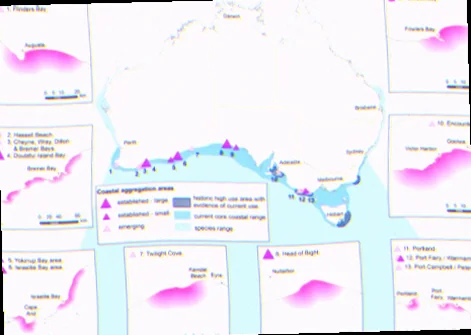
Ecological significance: Southern right whale nursery locations in South Australia function as critical nutrient-cycling hubs where megafauna facilitate the "whale pump," transporting nitrogen and iron from deep-sea feeding grounds to nutrient-limited coastal shelves. As high-level secondary consumers, these whales regulate zooplankton populations in the Southern Ocean while their presence in South Australian nurseries supports a complex scavenger community and stimulates primary productivity through fecal plumes. The loss of these nursery locations would lead to a collapse in local marine biodiversity and a significant reduction in the carbon sequestration capacity of the Great Australian Bight ecosystem.
Species Profile
| Attribute | Data |
|---|---|
| Scientific name | Eubalaena australis (Desmoulins, 1822) |
| Trophic level | Secondary consumer (specialised filter feeder) |
| Population estimate | Approximately 3,500 individuals in the western-central Australian sub-population (Bannister et al., 2021) |
| Native range | South Australia, Western Australia, Victoria, Tasmania, New South Wales; circumpolar Southern Ocean |
| EPBC Act status | Endangered |
Position in the Food Web
- Prey species: The southern right whale is a specialist feeder, primarily consuming copepods (e.g., Calanus species) and krill (Euphausia superba) via "ram feeding," where the whale swims forward with its mouth open, filtering organisms through baleen plates.
- Predators: The primary natural predator of southern right whale calves in South Australian waters is the Orca (Orcinus orca), while the Great White Shark (Carcharodon carcharias) is known to scavenge on carcasses and occasionally target distressed neonates.
- Competitors: In the broader Southern Ocean, they compete for krill biomass with the Blue Whale (Balaenoptera musculus) and various penguin species, though their specific nursery timing in South Australia reduces direct competition for resources during the fasting period.
- Symbiotic partners: These whales maintain a commensal relationship with whale lice (Cyamus ovalis, C. gracilis, and C. erraticus), which inhabit the callosities (rough patches of skin) on the whale's head, feeding on algae and dead skin without harming the host.
- Keystone role: The southern right whale is considered an umbrella species; by protecting their South Australian nursery habitats, conservation efforts simultaneously safeguard the diverse benthic and pelagic communities of the Great Australian Bight.
Habitat Requirements and Microhabitat Use
In South Australia, southern right whale nurseries are geographically restricted to specific coastal environments characterized by shallow, sheltered bays with sandy substrates and low-energy wave regimes. The most significant nursery is found at the Head of Bight within the Great Australian Bight Marine Park, where the towering Bunda Cliffs provide a degree of acoustic and wind buffering. These locations must have water depths typically under 10 metres to allow mothers to support calves during nursing and to provide protection from deep-water predators. The whales utilize the Eucla and Murat bioregions, seeking out areas where the bathymetry allows for "logging" (resting at the surface) and social interaction. These microhabitats are critical because mothers do not feed during their stay in South Australian waters, relying entirely on blubber reserves while providing high-fat milk to their rapidly growing calves.
Reproductive Strategy and Population Dynamics
The southern right whale employs a K-selected reproductive strategy, characterized by high parental investment, long lifespans, and low reproductive rates. Females typically reach sexual maturity between ages 5 and 10 and follow a three-year calving cycle: one year of gestation, one year of lactation/nursing, and one year of resting. Breeding triggers are closely linked to seasonal photoperiods and water temperatures, with whales migrating from sub-Antarctic feeding grounds to South Australian nurseries between May and October. Population growth is limited by this slow turnover and the availability of nutrient-dense krill in their summer feeding grounds. While the Australian population has shown a recovery rate of approximately 6-7% per annum since the cessation of commercial whaling, the species remains vulnerable to "stochastic events"-unpredictable environmental changes that can lead to high calf mortality in a single season.
Threats and Vulnerability Analysis
- Introduced species pressure: While direct predation by feral animals is not a factor, the introduction of invasive marine species via ballast water can alter the composition of local plankton communities, potentially impacting the ecosystem health of the nurseries.
- Land-use change: Industrial expansion, specifically offshore oil and gas exploration in the Great Australian Bight, poses a significant threat. Seismic testing involves high-intensity underwater noise that can displace mothers and calves from preferred nursery sites.
- Climate projections: By 2050, warming sea surface temperatures and changes in the East Australian Current are projected to shift the distribution of Antarctic krill further south. This increased migratory distance between feeding grounds and South Australian nurseries may lead to poorer body condition in mothers and lower juvenile survival rates.
- Disease: The species is susceptible to skin lesions and potential outbreaks of cetacean morbillivirus, which can be exacerbated by environmental stress and increasing ocean temperatures.
Recovery Actions and Research Gaps
Recovery efforts are guided by the National Recovery Plan for the Southern Right Whale, which focuses on habitat protection, the regulation of whale-watching activities, and the mitigation of ship strikes. In South Australia, the Great Australian Bight Marine Park implements seasonal closure zones to exclude industrial activity during the calving season. However, a critical research gap remains regarding the "acoustic budget" of nursery locations. Researchers currently lack comprehensive data on how chronic anthropogenic noise-from shipping and coastal development-masks the low-frequency vocalizations used between mothers and calves to maintain contact. Addressing this gap is essential for developing effective noise-management protocols in South Australian waters.
Ecological FAQ
Why is southern right whale nursery locations south australia important to its ecosystem?
These nurseries act as ecological "pumps." Whales consume massive amounts of nutrients in the Southern Ocean and release them in South Australian coastal waters via fecal matter. These plumes are rich in iron and nitrogen, which are often the limiting factors for phytoplankton growth. By stimulating these primary producers, the whales support the entire marine food web, from tiny invertebrates to commercial fish species.
How has the southern right whale nursery locations south australia population changed over the last 50 years?
Fifty years ago, the population was at a critically low level following centuries of unregulated whaling. Since the 1970s, the South Australian sub-population has seen a steady increase as a result of legal protection under the EPBC Act and international whaling bans. However, while the numbers are increasing, the population has not yet returned to its pre-whaling abundance, and the density of whales in specific nurseries like Encounter Bay remains lower than historical records suggest.
What can individuals do to support southern right whale nursery locations south australia conservation?
Individuals can contribute by participating in citizen science programs such as the South Australian Whale Centre's sighting logs, which provide researchers with vital data on migration patterns. Furthermore, adhering to boat approach distances and supporting policies that limit industrial noise in the Great Australian Bight are practical steps to reduce the stress on calving mothers. Reducing plastic consumption is also vital, as marine debris represents a significant entanglement risk for curious calves.